
Rear toe tuning is one of the most powerful tools in RC racing. This guide will simplify rear toe and show you how to use it to dramatically improve your RC vehicle’s handling, grip, and even speed.
Need Help?
If you have a question about this post or anything else on the site, leave a comment on any of my YouTube videos. I’m much more likely to see it there and get back to you. RCGuided-YouTube
This site contains affiliate links. When you click these links, you help the site grow. The site may receive a commission at no additional cost to you. As an Amazon Associate I earn from qualifying purchases and as an eBay Partner, I may be compensated if you make a purchase.
Quick Reference Summary: RC Rear Toe Tuning
This chart provides a rapid overview of everything you need to know about RC rear toe tuning for optimal car performance.
| Core Concept | Key Insight/Effect | Ultimate Benefit/Outcome |
| What is Rear Toe? | The angle of your rear wheels relative to the car’s centerline. | Fundamental for dialing in your RC car’s handling. |
| Toe-In (More) | Increases straight-line stability and on-power rear grip. | More predictable, “locked-in” feel; better corner exit stability. |
| Toe-Out (Less Toe-In) | Frees up the rear in turns, provides more responsive steering. | Increased corner speed, more agile feel; less power required. |
| Best Adjustment Method | Toe-block (suspension mount) keeps CV joints straight & efficient. | Minimized axle stress, consistent power, durable setup. |
| Smart Tuning Practice | Make small, isolated changes; keep a track journal; observe tire wear. | Efficiently find optimal setup; prolong tire life; learn effectively. |
| Common Mistakes | Over-adjusting; ignoring CV joint angle; not testing thoroughly. | Avoid unpredictable handling, premature wear, and wasted time. |
Guide Navigation
Use this table to quickly jump to the sections you’re most interested in:
| Section Title | What You’ll Learn | Quick Access |
| What is RC Rear Toe? | Fundamental definition and importance. | Jump to Section |
| Understanding the Effects | Detailed impact of increasing or decreasing rear toe. | Jump to Section |
| How to Adjust RC Rear Toe | Two primary methods (toe-block vs. hub) and which to prefer. | Jump to Section |
| Practical Tuning Tips | Actionable advice for effective setup changes. | Jump to Section |
| Common Tuning Mistakes | Pitfalls to avoid when adjusting your RC car’s toe. | Jump to Section |
| Mastering RC Handling | Final thoughts and next steps for advanced tuning. | Jump to Section |
What is RC Rear Toe, and Why Does it Matter So Much?
| Concept | Definition | Key Importance |
| Rear Toe | Angle of rear wheels relative to car’s centerline (top-down view). | Directly influences grip, stability, and handling. |
| Toe-In | Front of rear wheels point slightly inward (towards car’s center). | Common for off-road & on-road stability. |
| Toe-Out | Front of rear wheels point slightly outward (away from car’s center). | Less common for rear; generally reduces stability. |
Imagine looking down at your RC car from above. Rear toe refers to the angle of your rear wheels relative to the car’s centerline.
- Toe-in: This is when the front of your rear wheels points slightly inward, towards the center of the car. It’s the most common setting for off-road and many on-road setups.
- Toe-out: This is when the front of your rear wheels points slightly outward, away from the center of the car. This is less common for the rear, but understanding it helps.
Why is this angle so critical? Rear toe directly influences how your RC car tracks in a straight line, how it behaves entering and exiting turns, and ultimately, its overall grip and stability. It’s a fundamental adjustment that can transform your driving experience with minimal negative impact on other settings.
Understanding the Effects: Toe-In vs. Toe-Out
Adjusting your RC rear toe allows you to fine-tune your car’s handling for different track conditions, driving styles, and desired performance.
| Effect Category | Increasing Rear Toe-In (More Toe-In) | Decreasing Rear Toe-In (Less Toe-In) |
| Handling/Stability | High Straight-Line Stability, “Pushy” in turns (Understeer). | Lower Straight-Line Stability, “Freer” in turns (More Responsive Steering). |
| Grip/Performance | Increased On-Power Rear Grip, More Predictable Corner Exit. | More Consistent Grip through corners, Increased Corner Speed. |
| Efficiency/Wear | Slightly Reduced Overall Speed, More Power Required, Increased Tire Wear. | Potentially Increased Overall Speed, Less Power Required, Lower Tire Wear. |
Increasing Rear Toe-In (More Toe-In)
When you add more toe-in to your rear wheels, you’ll generally experience:
- Enhanced Straight-Line Stability: Your car’s rear will feel more “locked in,” especially at high speeds. This is fantastic for tracks with long straights or for consistent bashing.
- Increased Rear Grip (On-Power): As you accelerate, the wheels naturally pull forward, creating more forward traction. This is super helpful on loose surfaces like dirt or dust, keeping the rear from breaking loose easily.
- More Predictable Corner Exit: The extra grip helps the car drive straight out of a corner, making it less likely to spin out under acceleration.
- “Dull” or “Pushy” Steering: While stability improves, too much toe-in can make the car feel less responsive in turns, needing more effort to initiate a turn (known as understeer).
- Reduced Overall Speed: The wheels are slightly working against each other, creating more rolling resistance. This means your car needs more power to maintain speed and can lead to shorter run times.
- Increased Tire Wear: You might notice more wear on the inner edges of your rear tires due to the constant scrubbing.
Decreasing Rear Toe-In (Less Toe-In or Toe-Out)
Reducing toe-in (or even going to slight toe-out, though rarely recommended for the rear) will lead to:
- Freer Rear in Turns: Your car will rotate more easily into and through corners, giving you more responsive steering and a “looser” feel. This is often preferred on high-grip surfaces like carpet or asphalt.
- More Consistent Grip: Less toe-in can provide more consistent grip through the entire corner, as the tires aren’t fighting the car’s direction as much.
- Increased Corner Speed: With less rolling resistance, your car needs less power to carry speed through turns and can feel faster overall.
- Less Straight-Line Stability: Your car might feel a bit twitchier on long straights and require more steering input to keep it tracking straight.
- More Challenging On-Power Handling: On loose surfaces, the rear might want to break loose more easily under acceleration.
How to Adjust RC Rear Toe: Two Primary Methods
| Method | Key Advantage | Key Disadvantage |
| Toe-Block (Suspension Mount) | Consistent, efficient, minimizes axle stress, predictable handling. | Requires specific blocks for each angle, minor wheelbase change. |
| Hub Adjustment (Hub Carrier) | Quick adjustment (if inserts are available), no wheelbase change. | Increased friction, higher power consumption, inconsistent handling. |
You’ll typically adjust rear toe using one of two methods, each with its own advantages and considerations:
- Adjusting with a Toe-Block (Suspension Mount):
- This method involves replacing the rear “toe-block” or “anti-squat block” with one that has a different degree of toe built-in. These blocks are usually labeled with degrees (e.g., 2.5°, 3°, 3.5°, 4°).
- Why it’s generally better: Toe-blocks optimize your suspension’s inner pivot, allowing the outer CV (Constant Velocity) joint to stay much straighter as your suspension cycles. This means significantly less stress and friction at the wheel, improving power delivery. While the inner joint might experience a slight increase in angle, its limited movement will give less overall stress.
- Cons: will move your wheelbase slightly
- Adjusting with the Hub (Hub Carrier):
- Description: Some RC cars allow you to adjust toe directly at the rear hub carrier using inserts or different hub carriers.
- Considerations: While this method won’t shorten your wheelbase, we advise against exceeding roughly -1 degrees of adjustment on the hub. Why? Because adjusting toe at the hub significantly changes the angle of your CV joint. A highly angled CV joint creates more friction, consumes more power, and can cause inconsistent handling as the suspension compresses and extends. It essentially creates a “dogbone effect” where the axle is trying to push the wheel in and out as it spins.
Recommendation: Whenever possible, prioritize adjusting rear toe using a toe-block. It provides a more stable, efficient, and consistent setup, especially for performance-oriented driving.
Practical Tuning Tips for Your RC Car
- Start Small: When making any toe adjustments, begin with small increments (e.g., 0.5 degrees). Test the change thoroughly before making another adjustment.
- One Change at a Time: To truly understand the effect of rear toe, change only this setting during a tuning session. Avoid changing toe, camber, and shock oil all at once.
- Track Journal: Keep notes on your toe settings for different tracks, conditions (e.g., wet vs. dry), and tire choices. This will build your personal setup database.
- Observe Tire Wear: Pay attention to how your tires are wearing. Excessive wear on the inner edge of the rear tires can indicate too much toe-in.
- Balance is Key: Remember that every setup adjustment is a compromise. More stability might mean less steering. The goal is to find the right balance for your driving style and track.
Common Rear Toe Tuning Mistakes to Avoid
- Over-adjusting: Making large leaps in toe settings can make the car unpredictable and hard to diagnose.
- Ignoring CV Joint Angle: Failing to consider the impact on your CV joints when adjusting via the hub can lead to binding, inefficiency, and breakage.
- Not Testing Thoroughly: Don’t just make an adjustment and assume it’s better. Drive the car for several laps, pushing it in different scenarios (straight-line, tight turns, sweeping turns).
- Copying Setups Blindly: While a team driver’s setup might be a good starting point, it’s tailored to their driving style and their track. Always fine-tune it to your own needs.
Mastering Your RC Car’s Handling
Rear toe is a powerful yet often overlooked tuning variable. Understanding its impact and how to adjust it effectively will give you a significant edge in dialing in your RC car’s handling. Experiment, observe, and learn how this simple adjustment can unlock better grip, improved stability, and ultimately, faster, more consistent laps.
Ready to take your RC setup to the next level? Explore more of our Tuning guides.
Related posts:
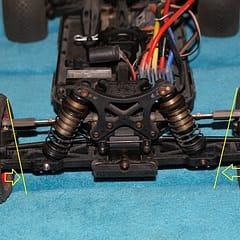 RC Front Toe Tuning (Simplified)
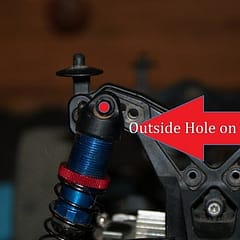 RC Shock Position Tuning (Simplified)
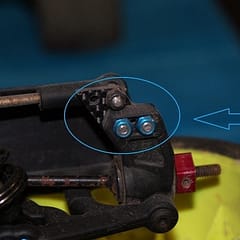 Tuning With Camber Links (Simplified)
 RC Roll Center Tuning (Simplified)
 RC Diff Oil Tuning (Simplified)
 RC Kick-Up Tuning (Simplified)
 RC Caster Tuning (Simplified)
 RC Center of Gravity Tuning (Simplified)
 RC Sway Bar Tuning (Simplified)
 Simplified Suspension Tuning Guides